
Owner-Builder vs Hiring a Builder in Florida
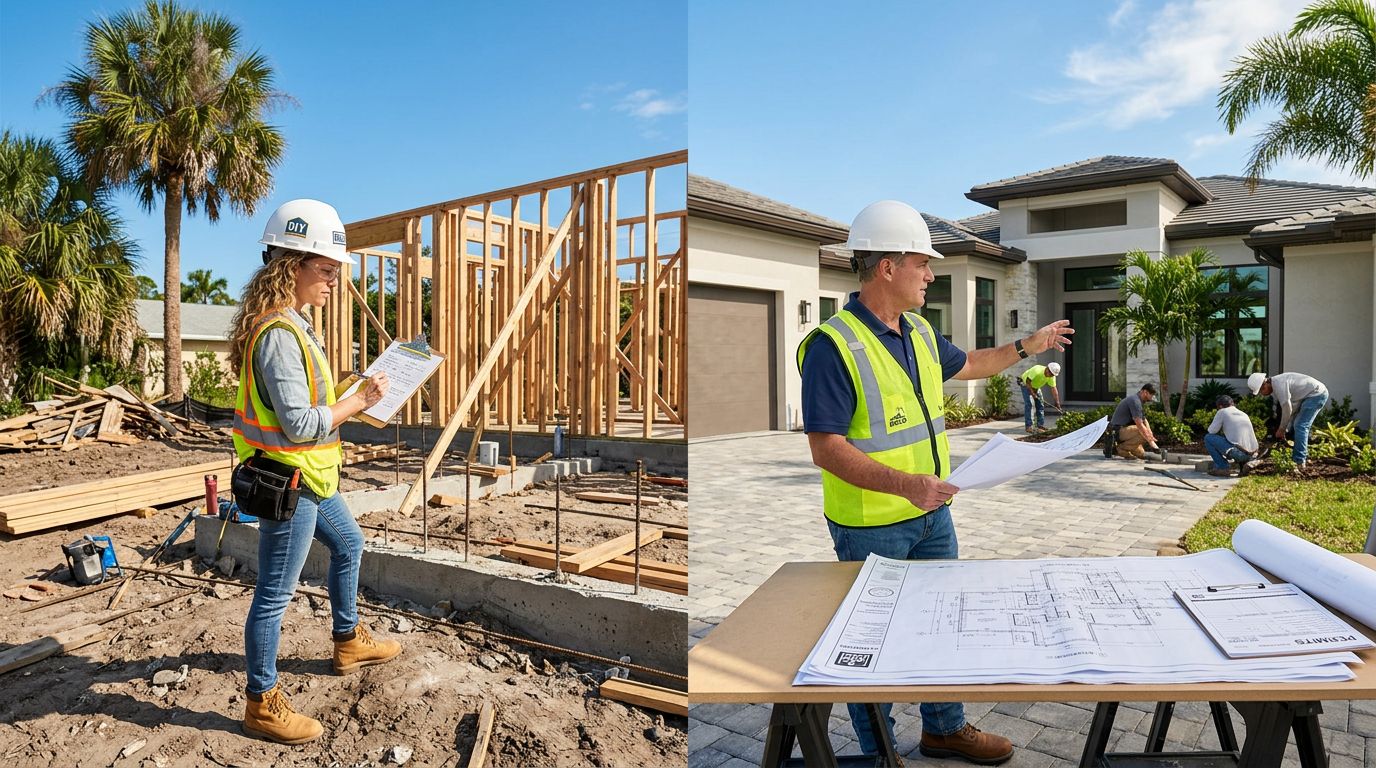
The owner builder Florida route can look like an easy way to save money, until the permits, inspections, and liability start stacking up. For some homeowners, it makes sense. For others, it turns a renovation or new build into a second full-time job.
If you're weighing both paths, the real question is simple: how much control do you want, and how much risk can you live with? The answer depends on your project size, your experience, and how much local code work sits behind the walls.
Key Takeaways
- Florida allows owner-builder permits in limited situations, but the rules are narrower than many people expect.
- Owner-builders take on direct supervision, permit responsibility, and more insurance exposure.
- Hiring a licensed builder usually costs more up front, but it reduces coordination, code, and liability headaches.
- Local permit offices can vary, so the same project may face different paperwork in different cities or counties.
- New construction, storm repairs, and structural remodels are often better handled by a builder.
What being an owner-builder really means in Florida
An owner-builder is not a passive homeowner watching a project unfold. In Florida, the owner is the person responsible for the permit, the supervision, and the work that happens on site. That means you are not just approving decisions, you are carrying them.
Florida law lets owners act as their own contractor for certain residential projects, but the exemption comes with strings attached. The property usually has to be for your own use and occupancy, and the title generally needs to stay in your personal name. If you try to sell or lease too soon after completion, that can create serious problems.
If you want the flexibility of an owner-builder permit, you also have to accept the accountability that comes with it.
In practice, the building department may ask for an owner-builder affidavit, proof of ownership, and your personal signature. Some local offices also want to know that you understand inspections, subcontractor coordination, and code requirements. Even when the paperwork is straightforward, the work behind it is not.
The biggest shift is this: once you file as owner-builder, the project is yours in a legal and practical sense. If you hire workers directly, you may also take on employer-like duties. That can include payroll, tax, and workers' compensation questions that many homeowners do not expect.
When the owner-builder path can make sense
Owner-builder can work well for a homeowner who already understands construction basics and wants hands-on control. It fits best when the project is smaller, the scope is clear, and the owner can stay on site often. A simple addition, a detached accessory structure, or a contained remodel may be manageable if the owner has the time and patience.
It can also make sense when you are comfortable vetting subcontractors yourself. If you know how to compare bids, check licenses, and keep trades on schedule, you can trim some overhead. That can help on projects where every dollar matters.
For a kitchen, bath, or storm-related update, professional home remodeling services may still be the better call if the work touches plumbing, structure, windows, or electrical systems. Once several trades need to line up in the right order, the savings from self-managing can shrink fast.
The upside of owner-builder control is clear. You choose the schedule, you choose the subs, and you stay close to the budget. The downside is also clear. If one subcontractor misses a step, the delay, rework, or inspection failure lands on you.
Owner-builder usually works best when all of these are true:
- The project is modest in size.
- You can be on site often.
- You understand local permit and inspection steps.
- You are comfortable handling problems as they appear.
- You are not relying on the project to finish by a fixed deadline.
What changes when you hire a licensed builder
Hiring a builder shifts most of the jobsite burden away from you. The builder handles scheduling, coordinates subcontractors, pulls together permit paperwork, and deals with inspections. That can remove a lot of stress, especially if the project is a full home build or a major renovation.
For a ground-up home, custom new home construction usually makes more sense when you want one company to handle the moving parts. Plans, trades, code details, and inspection timing all come together under one contract. That matters in Southwest Florida, where hurricane code rules, impact openings, and wind standards can affect almost every phase of the job.
A licensed builder also brings accountability. If the roof line is wrong, the windows are delayed, or the framing misses code, you have a single company responsible for fixing it. That does not make every problem disappear, but it does reduce finger-pointing.
There is a tradeoff, of course. Hiring a builder usually costs more than acting as your own contractor because you are paying for management, overhead, and profit. However, the extra cost often buys fewer mistakes, fewer inspections delays, and fewer surprise calls from the permit office.
Florida's newer home warranty rules also matter here. Newly constructed residential homes now carry a one-year warranty for certain defects tied to Florida Building Code violations. That gives buyers another layer of protection when they hire a builder for new construction.
Florida rules, permits, and insurance concerns that matter either way
Florida is not a place where you can treat construction lightly. Wind loads, roof tie-downs, impact-rated openings, flood elevation, and moisture control all matter. In Southwest Florida, those issues show up fast, especially on homes near the coast or in flood-prone zones.
Local rules can also change the process. One city may want extra documentation. Another may require different inspection timing. A county office may look at the same renovation differently if the home sits in an HOA or special district. That is why homeowners should always check with the local building department before they commit.
Insurance is another area where people get caught off guard. If you act as your own contractor and a worker gets hurt, or a jobsite mistake damages the property, your homeowners policy may not pick up the tab. You also need to think about how direct-hire labor, subcontractor coverage, and workers' compensation fit together. A low bid does not help much if an accident creates a large claim.
The same caution applies to hurricane repairs and major structural work. If the project touches windows, doors, roof framing, drywall after water damage, or insulation after a storm, code compliance matters more than speed. The safest choice is often the one that keeps the paperwork clean and the inspections smooth.
Side-by-side comparison of the two paths
A simple comparison can make the tradeoff easier to see.
| Factor | Owner-builder | Hiring a builder |
|---|---|---|
| Control | High, because you make the key calls | Lower day to day, but still informed by your contract |
| Cost at the start | Often lower | Often higher |
| Time required | High, because you manage the job | Much lower for the homeowner |
| Liability | Higher, because the owner carries more responsibility | Lower, because the builder carries most management risk |
| Best fit | Smaller, well-defined projects with a hands-on owner | New homes, structural remodels, and storm-related work |
The biggest difference is not price. It is risk. If you want fewer surprises, hiring a builder usually gives you a steadier path. If you want direct control and you know the construction process well, owner-builder can work on the right project.
How to choose the safer path for your project
Start with the scope. A simple interior remodel is one thing. A custom home, an addition, or a hurricane repair project is another. The more trades involved, the more helpful a licensed builder becomes.
Then look at your own time. If you cannot answer calls, meet inspectors, and handle changes during the workweek, owner-builder can become exhausting. Construction moves in small steps, and missed decisions can stall the whole schedule.
Next, look at the risk. If the project sits in a flood zone, involves structural changes, or needs permits from multiple departments, the safer choice is usually to hire a builder. If you are mainly updating finishes and can keep a close eye on the work, owner-builder may still be worth considering.
A few quick signals point toward hiring a builder:
- The job affects structure, roof lines, or openings.
- You need hurricane-ready materials or code upgrades.
- The home will need several inspections.
- The schedule matters because you are moving in or selling soon.
- You do not want to manage subcontractors directly.
The owner-builder path is more realistic when the project is smaller, the owner is highly organized, and the work stays within a narrow scope. Even then, the homeowner should be ready for permit paperwork, insurance questions, and local code checks.
Conclusion
Choosing between owner-builder and hiring a builder in Florida comes down to control, cost, and risk. The owner-builder route can save money on the right project, but it also puts the permit, supervision, and liability on your shoulders.
For many Southwest Florida homeowners, a licensed builder is the safer choice when the project is large, storm-sensitive, or tied to a fixed schedule. For a smaller, well-planned job, an experienced owner-builder may still be a good fit. The best decision is the one that matches your project, your time, and your comfort level with responsibility.
Get a Free Estimate
Considering building a new home in Southwest Florida or remodeling your current home to make it your dream house? Contact us today to start the planning process.
Fill out the form or call (239) 565-9486